Entries Tagged as 'Augmented Reality'

Vuzix Tac-Eye LT, The Future of War Today

Vuzix Tac-Eye LT

Vuzix, makers of a variety of head mounted displays, are bringing a new tactical heads-up display to the market. The Tac-Eye LT houses a 852×600 SVGA+ AMOLED display, which offers a number of advantages over LCD technology including more natural colors, smoother motion and unlimited viewing angles. The Tac-Eye LT can be attached to standard ballistic sunglasses such as those from Revision, ESS (shown above), and Oakley. Used in conjunction with an UMPC, you have yourself one very light and sporty wearable-computer.

Clearly targeting military applications, the unit is designed to withstand the harsh conditions of warfare with Vuzix also offering a ruggedized mouse, battery pack and in-line controller to boot. However the price also matches its military specs. At $2,495 for the VGA model, I find it hard to see any applications for the consumer market. However, Vuzix does have a number of mass-market product lines so hopefully this AMOLED display technology will trickle down into more affordable models. The Tac-Eye LT is available for pre-order now, and ships the beginning of next month.

link: Vuzix Tac-Eye LT [pre-order]

Arcstream’s “Living Image” Lets You Play Jesus, Walk on Water

Arcstream's Living Image

Arcstream, makers of totally extravagant and innovative display solutions, recently demoed their “Living Image” installation. The setup, consisting of a 6,500 lumens projector pointed at the ground and an array of infrared sensors, allows multiple users to walk on top of and interact with the imagery displayed below. Similar setups have been shown at many conventions, this isn’t the first use of the concept, but its very well executed never-the-less. Video included after the break…

[Read more →]

Microsoft Develops Hands-Free Data-Glove

VR Data-gloves

Researchers at Microsoft are hard at work developing an arm-band that can recognize finger movements simply by monitoring muscle activity. Initial tests show the system with as high as 95% accuracy for all 10 fingers and can even register varying levels of pressure. The end result is a unobtrusive hands-free device that can mimic control of something like a data-glove. MS claims this technology can be far more accurate than other more established forms of gesture controls (such as computer vision based solutions).

This device might be useful in mobile applications, also in virtual or augmented reality environments, where a stationary keyboard and mouse setup fails miserably. I imagine using a band like this you could leverage your second hand to aid in typing text messages on a cell-phone, or even better, performing some clandestine wifi hack while sipping a latte in Starbucks looking incognito. Still, most of this experimental technology that Microsoft develops rarely makes it into an actual product. It will be interesting to see if this ever materializes.

link: High-tech armband puts your fingers in control [NewScientist]

Psuedo-Interactive Hologram Girl Disintegrates At The Wave of Your Hand

AirStrike: Interactive Hologram

This little demo from LM3Labs is really quite alluring. They’ve released a video showing a life-sized 3d avatar displayed on what looks like a specially treated sheet of glass and a back-projector. From what I can see, this isn’t a true “hologram” in the sense of the word since it would need to be viewable from any 3d angle. Even so, this is probably the closest to a “help me Obi-Wan Kenobi” moment I’m sure all you Star Wars geeks have been clamoring for.

The creators had this to say, something I can definitely dig:

We believe more in growing the digital world into the real life. This requires new types of display, like real size holography technologies, but also, and more importantly, different interaction methods. No more mice, trackpads, only free-air interactivity can accomodate this vision.

More and more I feel like it is the legacy of the archaic QWERTY keyboard, which was designed specifically to be the most inefficient layout, and the restrictive 2D mouse which are holding back true next-generation 3D computer interfaces. The ultimate computer interface would be that which was wetwired directly into the brain, but the next logical step would be free-form gesture recognition. This type of interactivity is completely feasible with current hardware. The new depth cameras coming out later this year will also aid to this field of development. 3D capable LCD displays are already a reality, the iz3D is on sale for $700 at NewEgg, the Zalman is only a little more. Exciting times, I can’t wait to see what’s next.

Click the link below to check out the video.

link: Embedding the Digital World into Real Life // via: Engadget

Tagged In Motion: Augmented Reality Art

DAIM: Tagged in Motion

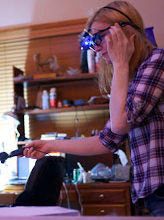
Although this is a tad old, I didn’t see it widely posted so here it is. Tagged in Motion is an augmented reality based 3d graffiti art simulation. In a way it could also be considered performance art, as the process is just as important as the final output. The German artist, DAIM, dons a sporty HMD and is able to use tracking-markers to position his virtual can of spraypaint in full 3d. This allows the user full freedom to use his real-life surroundings as a virtual 3d canvas. Judging from the tracking markers, a common convention of augmented reality, it looks like they may be using the ARToolKit but they could easily have their own solution.

Video and rant after the jump.

[Read more →]

Totally Underwelming AR Avatar

Augmented Reality Mascot

YDreams, a Portuguese ad firm, recently posted a video of their new augmented reality mascot, Flapi. While the demo is rather crude, and the avatar is controlled with a gamepad not AI, its at least a step in the right direction. The company’s profile mentions the paradigm of “reality computing” which they define as:

Reality Computing, which seeks to integrate the digital universe into the real world by creating systems that envelop the user’s senses and establish new approaches for interacting with technology without the conventional use of wires and keyboards.

Video included after the break.

[Read more →]